

From FDM to SLS: BNP's Sinterit Lisa X Case Study
Last Updated: May 16, 2026
Reading Time: 5 Minutes
Last Updated: May 16, 2026
Reading Time: 5 Minutes
Browse products related to the article


$38,160.00
BNP has spent more than 25 years building ergonomic solutions for industrial production. Its assembly-line equipment uses carbon-fibre tubes and lightweight components to reduce operator fatigue and prevent injury. The functional parts holding these assemblies together must be strong, dimensionally precise, and visually clean.
The team brought 3D printing in-house in 2018 with FDM. Five years later, the limits of FDM were holding the design back. BNP went looking for a compact SLS 3D printer. This Sinterit Lisa X case study tracks what changed once the new machine arrived.
FDM gave BNP a fast lift in production capacity, but two limits kept showing up.
First, FDM parts need supports. Removing them leaves a rough finish on functional surfaces, which mattered for components customers and operators see every day. Second, FDM parts were not strong enough to act as load-bearing parts in BNP’s ergonomic kit. Sinterit reports this strength-and-finish gap is the most common trigger Italian and European SMEs cite for moving from FDM to SLS.
The team also wanted a single-piece print capability. Splitting parts and bonding them adds labour, weak points, and visible seams. Background on the process sits in our guide on what is selective laser sintering and how it works.
Compact SLS technology made the switch viable. A decade ago, an industrial SLS machine often started above 100,000 EUR. The current generation of compact SLS printers, including the Sinterit Lisa X, brings the same process into the price range of an SME R&D budget.
BNP chose the Lisa X because it was the fastest and largest of Sinterit’s compact SLS line at the time. The build volume let them produce most of their components as single parts, an option ruled out on competing SLS machines they had evaluated.
Alberto Parolin, R&D Team Leader at BNP, summed it up:
Although we have been looking for a bigger SLS 3D printer, getting Lisa X solved a lot of our problems. It has a big enough printing area, so we almost always can print big components in one part. It wouldn’t be possible with competitive SLS 3D printing solutions.
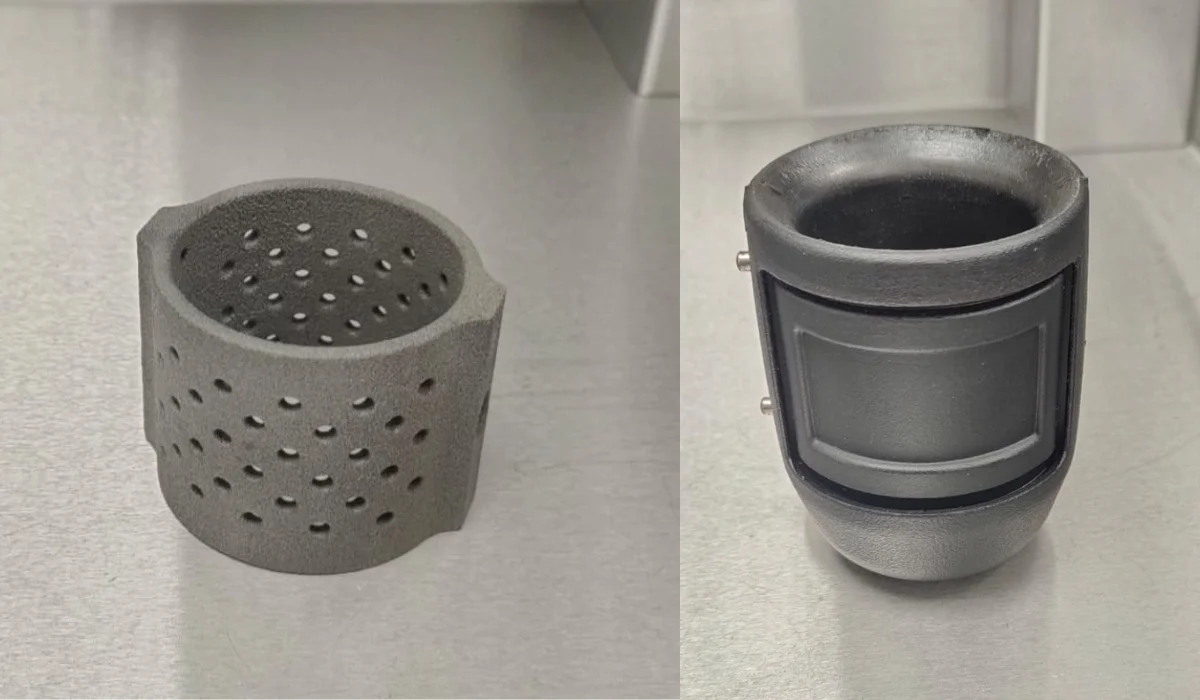
Two examples illustrate where the printer earns its place on the BNP shop floor.
The first is the core component of BNP’s tool holster, sometimes described as the “soul” of the assembly. The SLS-printed part is then co-moulded with polyurethane to form the final holster. The geometry needs dimensional accuracy and surface finish beyond FDM’s reach.
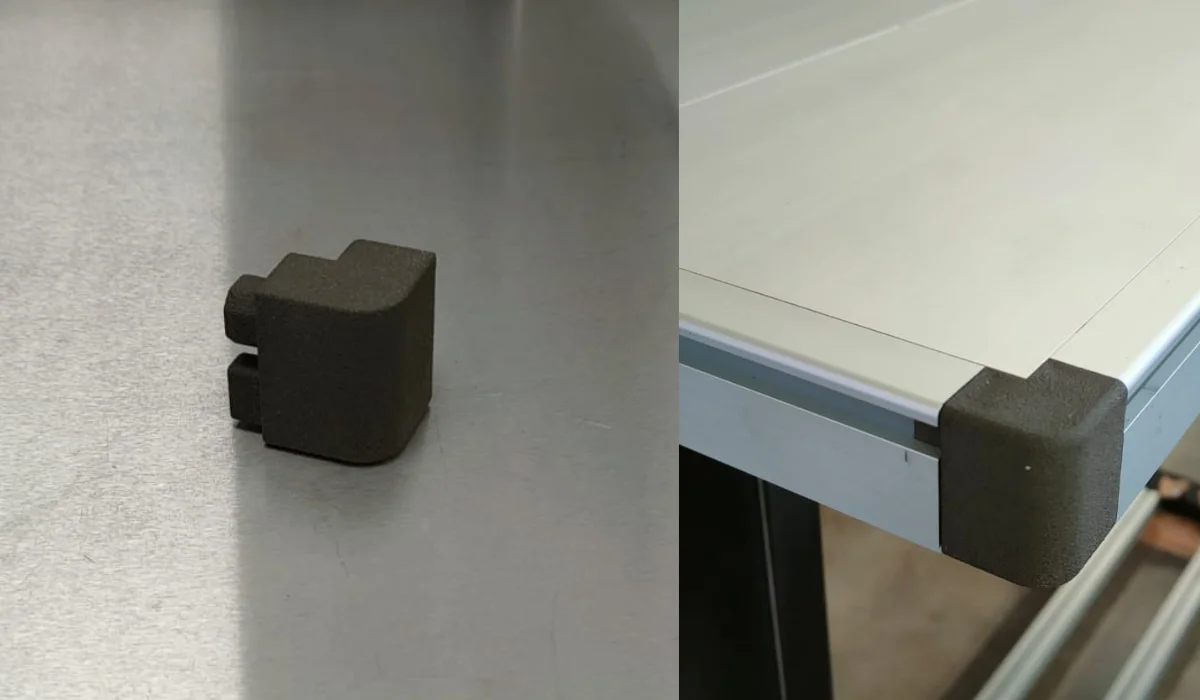
The second is the end cap used to close the edges of BNP’s modular desk system. The cap is a functional and visible part, so smooth surfaces and consistent geometry matter for both performance and product appearance. Both examples sit at the centre of this SLS 3D printing case study because they show where finish and strength meet visible end-customer use.
Most BNP prints use PA-12 Industrial Powder, the standard workhorse for Lisa X production. The team is now moving selected parts to PA-11 CF, a carbon-fibre-reinforced powder. PA-11 CF gives BNP a path to replace some aluminium and existing carbon-fibre tube assemblies with a printed equivalent.
BNP runs the full Sinterit post-processing line alongside the printer. The kit includes the Multi-Function Powder Handling Station, the Sandblaster for SLS, and the ATEX Intertek Vacuum Cleaner. The combination keeps powder handling contained, finishes parts to a consistent surface, and meets the explosive-atmosphere safety requirements for working with fine polymer dust.
Distributor support also helped the rollout. Parolin added:
We also got a lot of support from local italian distributor, Manufat, which makes it even easier to start printing and exploring the possibilities of SLS.
The lessons in this Sinterit Lisa X case study mirror the path many Australian SMEs follow. An in-house FDM setup proves the value of 3D printing, then strength and finish limits push the team towards SLS. The Lisa X sits in the same procurement bracket Australian R&D managers tell us they target, with a build volume large enough for most functional and end-use parts.
For teams weighing the Lisa X against the smaller Sinterit Suzy, the comparison comes down to part size, throughput, and powder cost per part. Both run the same compact-SLS principle. Our Suzy vs Lisa X comparison sets the trade-offs out in detail, and our guide on how to manufacture with SLS covers the production workflow end-to-end.
What is SLS 3D printing and how is it different from FDM?
SLS uses a laser to sinter fine polymer powder into solid layers, building parts inside a bed of unsintered powder. No supports are needed because the surrounding powder holds the part. FDM extrudes molten plastic layer by layer and requires printed supports for any overhang. SLS parts are stronger, have smoother surfaces, and handle more complex geometries.
Why did BNP move from FDM to SLS?
BNP needed stronger functional parts and cleaner surface finishes than FDM was able to deliver. Support removal on FDM left rough finished surfaces, and FDM strength was not enough for some load-bearing components. SLS removed both issues in a single equipment change. The Sinterit Lisa X case study above sets out the parts, materials, and post-processing kit BNP put in place.
What is the Sinterit Lisa X used for at BNP?
BNP prints the structural core of its tool holster, co-moulded with polyurethane after the print, and the end caps for its modular desk system. Both parts are functional and visible, so they need SLS-grade surface finish and dimensional accuracy.
Which Sinterit powders does BNP use?
BNP uses PA-12 Industrial Powder for most prints. The team is moving selected components to PA-11 CF, a carbon-fibre-reinforced powder, with the goal of replacing some aluminium and traditional carbon-fibre parts with printed equivalents.
How much does the Sinterit Lisa X cost in Australia?
The Lisa X is listed at AUD 37,734.99 on australian3dprinters.com.au, with packages and powder bundles also available. The price brings industrial-grade SLS into the same procurement bracket as a high-end FDM setup with full post-processing.
Want to view the full range of Sinterit products? Click here.
Browse products related to the article
$38,160.00