

Jetson One: SLS 3D Printing Aerospace Case Study with Sinterit Lisa X
Last Updated: May 16, 2026
Reading Time: 6 Minutes
Last Updated: May 16, 2026
Reading Time: 6 Minutes
Browse products related to the article


$38,160.00
Jetson One looks like science fiction. It is a single-seat personal aircraft built to take off vertically, hover, and land on a footprint smaller than a car space. Behind the carbon-fibre shell sits a quieter story about how Jetson builds the aircraft. Sinterit reports the team uses SLS 3D printing aerospace workflows to produce both 3D printed prototypes and end-use parts on the compact Sinterit Lisa X. This additive manufacturing case study explains why the choice reshaped how Jetson moves from CAD to flying hardware.
Jetson is a Swedish startup founded by Tomasz Patan and Peter Ternström. Their goal sounds simple. Make a personal flying vehicle almost anyone learns to operate. The production aircraft has two controls. A height stick and a go stick. First customer deliveries began in late 2023, and Jetson has continued production handovers through 2025 and into 2026.
Weight is the single hardest constraint on the design. Every gram saved on the airframe becomes flight time or passenger payload. Lattice structures and hollow brackets give stiffness without mass. Additive manufacturing earns its place exactly there.
"Right now you look at the car and you instantly know: oh yes, I can drive that. We want people to feel the same when they look at an aeroplane," says Alec Bialek, Head of R&D at Jetson.
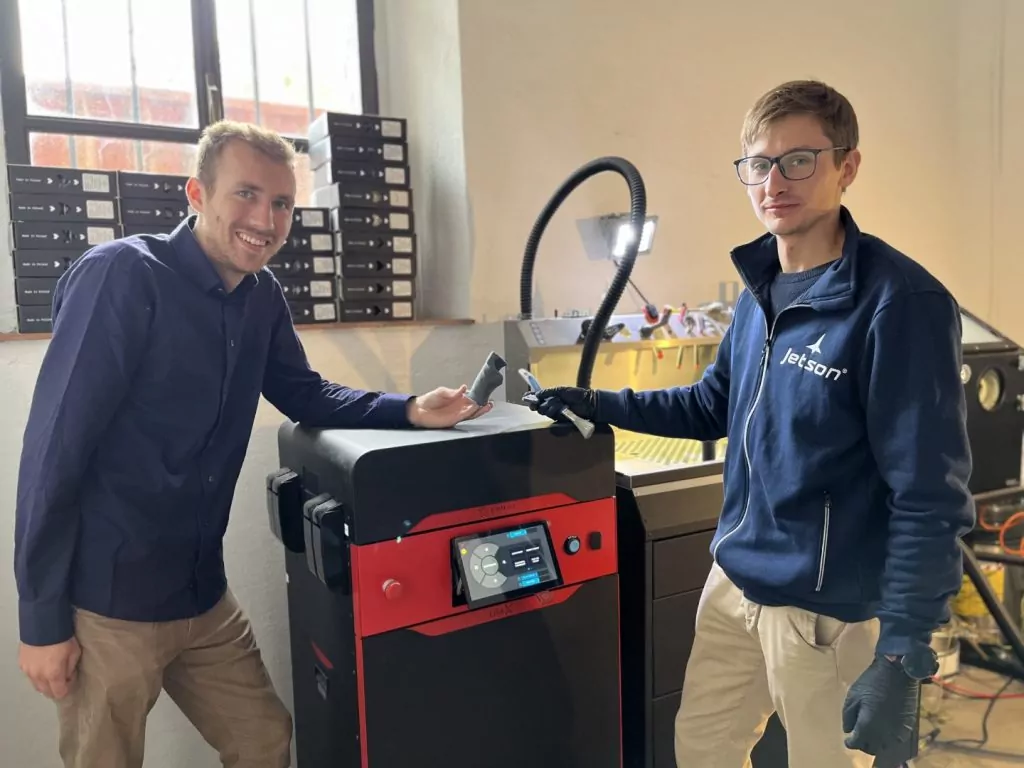
Sinterit reports Jetson evaluated FDM and SLA before settling on selective laser sintering. The decision came down to three things. Part quality, isotropic strength, and the absence of support structures.
"The print quality is much better than with FDM. As Jetson One is a premium vehicle,,, we do care about the quality of the parts coming out and the quality associated with SLS is unrivaled. The material properties are better when compared with FDM, and there isn't a need for support material. That is a big advantage when we try to heavily lightweight our structures," explains Bialek.
SLS prints lattice geometries and thin internal walls beyond what FDM reaches. The unsintered powder supports each layer as it prints, so no break-away supports are needed. For an aircraft where every internal cavity matters, the gap decides whether a part flies or gets redesigned. For background on the process, our explainer on what is selective laser sintering and how it works covers the fundamentals.
Jetson uses the Sinterit Lisa X across a wider range of components than a typical prototyping workflow.
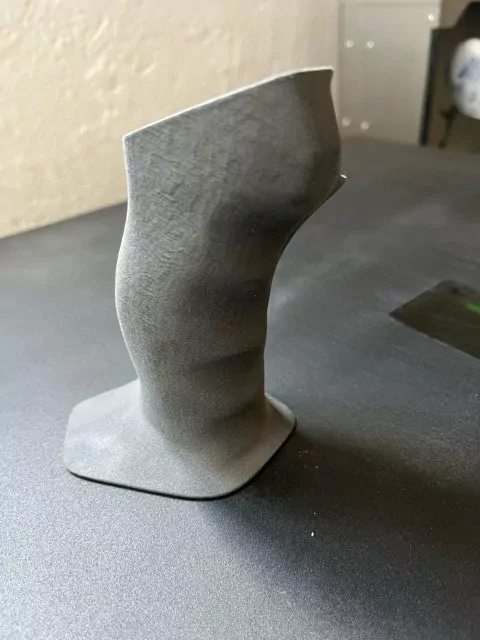
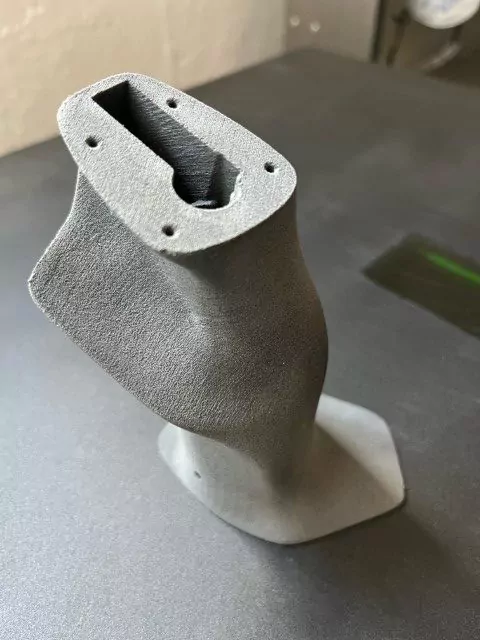
Motor speed controller brackets fastening the inverters to the welded aluminium space frame.
Bezel trim for the instrument cluster on the pilot's console.
Radar and GPS antenna housings printed as final, flight-ready parts.
Assembly jigs and drill guides used on the production line to position parts on the chassis.
All of these print in Sinterit PA12, a tough thermoplastic nylon powder rated for end-use components.
"We have welded aluminum space frame and we need to know where to mount all of the different components on it. So we are able to 3d print jigs, and drill guides which makes it for us a swift process to go from CAD to the actual product," says Bialek.
Jetson started on the older Lisa Pro before upgrading to the Lisa X. The new printer changed the maths on build size and throughput at the same time.
"Our transition to Lisa X was driven by a few things. The volume is so much larger. Once you are trying to find a 3D printer with a bigger print volume they are getting outrageously expensive. The Lisa X was a very good value for print volume, and print speed is 10 times faster than on Lisa Pro, which we upgraded from. So we are able to print significantly bigger parts in way less time," lists Bialek.
Local distributor support mattered as well. Sinterit's Italian partner, Manufat, ran the two-day on-site install and trained Jetson's operators on Sinterit Studio, post-processing, and machine maintenance. The relationship continues after handover, with quick technical answers when new questions come up.
Bialek also notes hardware refinements between generations. The upgraded screen tilts for easier operator use, and daily servicing is simpler than on the Lisa Pro.
What works for a Swedish eVTOL startup translates well to Australian aerospace, defence, and motorsport teams. The constraints are the same. Tight weight budgets. Low-volume runs with no case for injection moulding. Iteration cycles measured in days, not weeks.
Compact SLS systems like the Lisa X put production-grade 3D printing in manufacturing industry workflows inside a single lab. No 200-square-metre floor plan. No three-phase power upgrade. No half-million-dollar capital request. We have seen Australian research labs adopt the same approach for drone airframes, motorsport brackets, and medical device 3D printed prototypes. For a practical walkthrough, our guide on how to manufacture with SLS printing covers part design, post-processing, and powder management.
What 3D printing technology does Jetson One use?
Jetson uses selective laser sintering (SLS) for 3D printed prototypes and end-use parts on the Jetson One personal flying vehicle. Sinterit reports the team chose SLS for its print quality, lattice capability, and absence of support material.
Which Sinterit printer does Jetson use for aircraft parts?
Jetson uses the Sinterit Lisa X for production parts and prototypes. The team upgraded from the older Lisa Pro to gain a larger build volume and a 10 times faster print speed.
Is SLS strong enough for aerospace applications?
SLS is strong enough for non-load-bearing aerospace components, jigs, brackets, and tooling. Sinterit PA12 has the tensile strength, heat resistance, and dimensional stability needed for flight-line and assembly parts on aircraft like the Jetson One.
What material does Jetson print with on the Lisa X?
Jetson prints with Sinterit PA12 powder. PA12 is a nylon thermoplastic used across aerospace, automotive, and consumer manufacturing for its strength, surface finish, and chemical resistance.
How does the Lisa X compare with the Sinterit Suzy?
The Lisa X is the established compact SLS workhorse with a proven track record at companies including Jetson. The newer Sinterit Suzy targets larger build envelopes and faster cycles for production teams. See our Suzy vs Lisa X comparison for the full breakdown.
Want to explore Sinterit SLS 3D printing for your aerospace, defence, or advanced manufacturing team? View the Sinterit range.
Browse products related to the article
$38,160.00