

What is SLS 3D Printing? A Complete Guide for Australian Manufacturers
Last Updated: May 17, 2026
Reading Time: 10 Minutes
Last Updated: May 17, 2026
Reading Time: 10 Minutes
Browse products related to the article


$38,160.00


$33,250.00
What is SLS 3D printing, and why does it matter for Australian engineering and manufacturing teams? SLS 3D printing uses a laser to fuse plastic powder into strong, working parts. No supports. No tools. Layer by layer powder fusion, building parts ready for real-world load.
This guide walks through the SLS process, the hardware, the materials, the uses and how it stacks up against other 3D printing methods. By the end you will know if SLS 3D printing fits your needs, and which Sinterit printer suits it best.
SLS 3D printing, or selective laser sintering, is a powder-bed fusion method. A laser scans across a heated bed of plastic powder. It fuses the powder one cross-section at a time. The build plate then drops, fresh powder is spread on top, and the laser repeats. Layer by layer, a solid part forms inside the powder.
The defining trait of SLS is the powder itself. Unfused powder holds up the part as it grows. That means you can build sealed cavities, locked-together assemblies and nested parts in one print. No support material to clean off.
For Australian makers running short-batch jobs or working prototypes, SLS sits between FDM (cheap, fast, rough) and injection moulding (costly, slow to set up, high volume). It gives you factory-grade strength without the tooling cost.
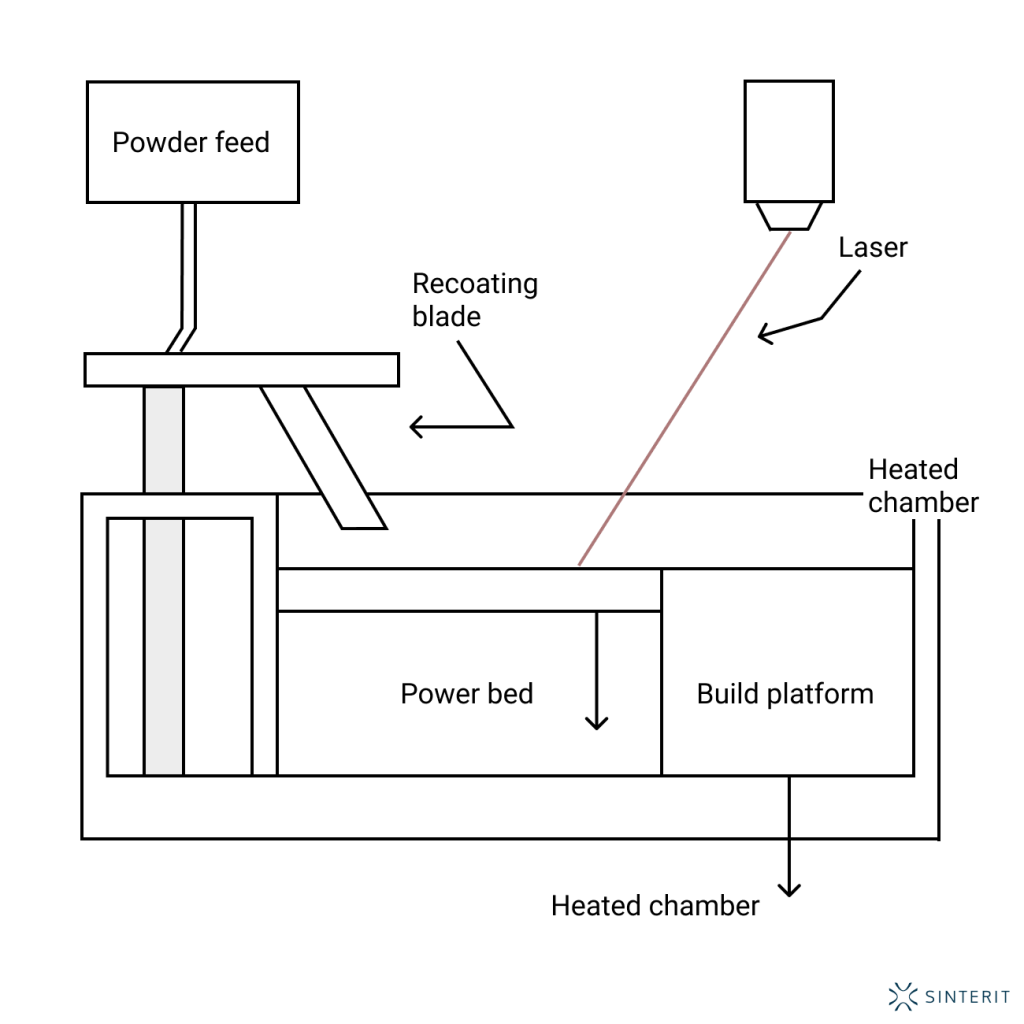
The SLS 3D printing process runs in five steps inside a heated build chamber:
A thin layer of plastic powder spreads across a heated plate.
A laser scans the part's cross-section and fuses the powder.
The plate drops by one layer.
A blade spreads a fresh layer of powder on top.
Steps 2 to 4 repeat until the part is done. The print is then pulled from the powder cake and cleaned.
The chamber stays slightly below the powder's melting point the whole time. That preheat cuts warping. It keeps layer bonds even. And it lets the laser do less work for the same result.

An SLS printer is a pro-grade 3D printer built for plastic powders. Inside the cabinet sits a powder feed system, a recoating blade, a laser scanner and a heated build chamber.
SLS printers range from compact benchtop units to full factory systems. At Australian 3D Printers we stock two Sinterit options that cover most Australian needs:
Sinterit Lisa X: the fastest SLS printer in Sinterit's range. Built for high-volume jobs and working prototypes, at a price below most factory units.
Sinterit Suzy: a compact, lower-cost SLS option. Built for design studios, R&D labs and teachers stepping up from FDM.
Both fit in a small lab or office bay. Neither needs the dedicated room that older factory SLS hardware demands.
No. Standard SLS printers print plastics only. SLS stands for selective laser sintering. It refers only to plastic powder fusion.
The closest metal options are DMLS (direct metal laser sintering) and SLM (selective laser melting). Both sit in the same powder-bed fusion family as SLS. They use a much stronger laser and a metal powder feedstock. The core idea is the same. The materials, heat levels and safety needs are not.
For plastic parts that act like injection-moulded plastics under load, SLS is the right pick. For metal parts, look at DMLS or SLM systems.
The three most common pro 3D printing methods handle different jobs. The table below shows where SLS earns its place against FDM and SLA.
| Feature | FDM | SLA (Stereolithography) | SLS (Selective Laser Sintering) |
|---|---|---|---|
| Material type | Thermoplastic filament | Liquid photopolymer resin | Thermoplastic powder (PA12, PA11, TPU) |
| Support structures | Required for overhangs | Required | Not required (powder supports the part) |
| Surface finish | Visible layer lines | Very smooth | Matte, slightly grainy |
| Mechanical strength | Moderate, anisotropic | Moderate, brittle | High, isotropic |
| Design freedom | Limited by supports | Limited by supports | Excellent (nested, enclosed, interlocking) |
| Post-processing | Support removal | Cleaning + UV cure | Depowdering, bead blasting, optional dye |
| Best for | Concept models, jigs, tooling | Visual prototypes, dental, jewellery | End-use parts, functional prototypes, low-volume production |
| Common industries | Manufacturing, education | Dental, design, jewellery | Aerospace, automotive, medical, consumer products |
The short version: FDM is for fast and cheap. SLA is for fine detail and surface finish. SLS is for parts that need to perform.
The powder choice drives nearly every result in SLS: strength, flex, accuracy and clean-up time. Sinterit's powder range covers the full set of needs Australian buyers ask about.
PA-12 Industrial Powder (10kg): the workhorse. Strong, accurate, fit for end-use parts and working prototypes.
PA-12 Smooth Powder (10kg): finer grain for a smoother finish and sharper detail.
PA-11 Onyx Powder (10kg): tougher than PA-12, with a clean black finish.
PA-11 CF Fresh Powder (10kg): carbon-fibre reinforced for stiff load-bearing parts.
PA-11 ESD Powder (10kg): static-safe for electronics housings and ESD-sensitive areas.
PA-11.5 Powder (10kg): a strong polyamide with great layer bonding, used widely in orthopaedic work.
Flexa Performance TPU Powder (10kg): flexible, impact-soaking TPU for gaskets, soft-touch parts and footwear.
Polypropylene (PP) Powder (10kg): chem-safe and light, suited to fluid handling and packaging.
Picking PA12 or PA11 usually comes down to one trade-off. Need accuracy and stiff parts? Pick PA12. Need impact resistance and give? Pick PA11. For flexible parts, the Flexa TPU is the only fit in this size class.
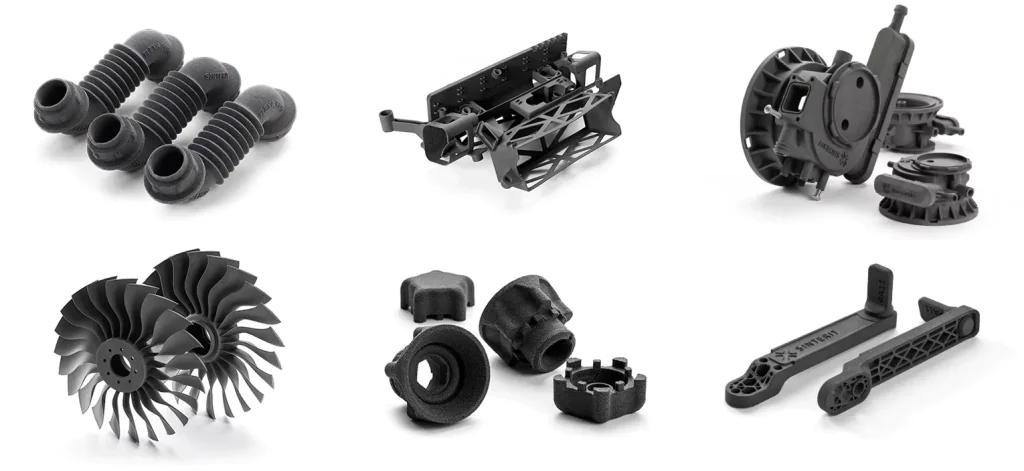
SLS prints turn up in sectors where parts have to work, not look right alone. Three use areas drive most Australian demand.
Working prototypes. Engineers use SLS-printed prototypes to test fit, function and load before paying for tooling. PA12 and PA11 act much like injection-moulded nylon. So an SLS prototype can go straight into the real product and get tested in real use. That shortens design cycles by a lot.
Low-volume jobs. Injection moulding tools cost a lot and take time to set up. For runs under a few thousand parts, SLS bridges the gap between prototypes and full-scale runs. End-use parts, brackets, ducts, housings and spare parts can be printed on demand. No minimum order needed.
Aerospace and motoring. Light, complex shapes that can't be machined are SLS's home turf. Two Sinterit case studies show the breadth:
Octoclassic Case Study: final car parts made in PA11 for high-strength use.
Munich Motorsport Case Study: over 100 SLS parts in a single racing car build.
Medical devices. Bio-safe powders and patient-specific shapes make SLS a fit for orthotics, prosthetics, surgical guides and anatomical models. Two more Sinterit case studies:
ECA Medical Case Study: medical device build with tight tolerance control on the Lisa platform.
Institute for Multiscale Simulation Case Study: printing organ phantoms that mimic human tissue for research.
For more on real-world SLS production, see our companion guide on SLS 3D printing for manufacturing. To browse all applied uses, visit our case studies page.
Three things decide if an SLS print acts like an injection-moulded part or fails on the first load test: build angle, powder choice and process control.
Build angle and nest layout shape both finish and strength. Build angle sets where layer lines fall on the part. Nest your prints to even out heat across the chamber, cut stair-stepping on key faces, and pack more parts into one build for higher output.
Powder choice drives how the part behaves. PA12 and PA11 give injection-mould strength. TPU gives stretch. PA11 CF adds stiffness. Match the powder to the load case, not the other way round.
Process control covers the dull but key bits. Powder refresh rate, laser tuning, chamber heat and the age of unfused powder all affect part accuracy. Sinterit's print profiles handle most of this for you. The one bit left is operator care around powder hygiene.
Clean-up turns a raw print into a finished part. The basic steps are powder removal, bead blasting and optional dyeing. For tight-fit assemblies, light bead blasting on mating faces is usually enough.
The case for SLS comes down to four key wins.
No supports needed. Inner cavities, lattices and snap-fit parts print as one piece.
Factory-grade strength. PA12 and PA11 SLS parts test close to injection-moulded parts in tensile, flex and impact tests.
Real low-volume runs. No tooling, no minimum order. Print 1 part or 100 parts on the same build.
Compact, lab-friendly kit. Sinterit's Lisa X and Suzy fit on a benchtop. Older factory SLS systems do not.
For Australian makers weighing buy-vs-outsource on working 3D printing, a Sinterit SLS printer often pays back in 12 to 18 months. The exact payback depends on your part volume and what you outsource now.
For a deeper look at which Sinterit printer suits which use case, read our Suzy vs Lisa X comparison.
What is SLS 3D printing?
SLS 3D printing is a 3D printing method where a laser fuses plastic powder layer by layer to build solid parts. The unfused powder holds up the build, so no supports are needed. SLS makes strong, working parts that suit both prototypes and end-use components.
What does SLS stand for in 3D printing?
SLS stands for selective laser sintering. It is a powder-bed fusion method. A laser scans across a bed of plastic powder and fuses the grains into a solid cross-section, one layer at a time.
How does SLS 3D printing work?
The SLS 3D printing process spreads a thin layer of plastic powder across a heated plate. A laser scans the part's cross-section and fuses the powder. The plate drops, fresh powder is spread, and the cycle runs again until the part is done. The print is then pulled from the powder cake and cleaned.
What materials are used in SLS 3D printing?
SLS uses plastic powders. The most common are PA12 and PA11 nylons for strong working parts. TPU is used for flexible parts. PP is used for chem-safe parts. Sinterit's range covers all four families.
Can SLS print metal?
No. Standard SLS printers handle plastic powders only. Metal 3D printing uses DMLS (direct metal laser sintering) or SLM (selective laser melting). Both sit in the same powder-bed fusion family but use a much stronger laser and metal powders.
How strong are SLS prints?
SLS parts in PA12 or PA11 are close to injection-moulded nylon in tensile, flex and impact tests. They are also isotropic, which means strength is the same in every direction. That is rare in 3D printing.
What is the difference between SLS and SLA?
SLA cures liquid resin with light to make smooth, high-detail visual parts. SLS fuses plastic powder with a laser to make strong, working parts. SLA suits prototypes and dental or jewellery work. SLS suits end-use mechanical parts.
Can SLS print internal structures or assemblies?
Yes. Because unfused powder holds up the build, SLS can print sealed cavities, locked-together parts and pre-built mechanisms in one print. Few other 3D printing methods can do this.
What are common applications of SLS 3D printing?
SLS is used widely for working prototypes, low-volume runs, custom parts, jigs and fixtures, aerospace parts, car parts, medical devices and electronics housings. Any job that needs durable, stable plastic parts is a fit.
Do SLS prints need post-processing?
Yes. The basic step is powder removal, which takes the unfused powder off the part. Bead blasting then smooths the finish. Optional dyeing gives a clean colour. For tight-fit assemblies, light machining of mating faces is often added.
Want to view our full range of Sinterit SLS 3D printers? Click here.
Browse products related to the article
$38,160.00
$33,250.00