

3D Printed Orthopaedic Insoles: Paul Hast Case Study
Last Updated: May 16, 2026
Reading Time: 6 Minutes
Last Updated: May 16, 2026
Reading Time: 6 Minutes
Browse products related to the article


$38,160.00


$33,250.00


$1,309.00
Fußorthopädie Paul Hast GmbH has built 3D printed orthopaedic insoles into the core of its production workflow. This 100-year-old Hamburg firm spent decades relying on injection moulding and TPU-based 3D printing. Both methods produced wearable insoles, but neither matched the design freedom, lightness, and durability modern patients now expect. Sinterit reports those older methods hit a ceiling on biomechanical precision once volumes climbed.
Selective laser sintering rewrote the playbook. With the Sinterit Suzy and PA11.5 powder, Paul Hast turned patient-specific insole work into scalable digital insole production. Hardware and material now sit at the centre of premium patient care.
Before adopting SLS, the team tested fused deposition modelling on a Bambu Lab printer. FDM proved useful for prototyping and fast design checks. It ran cheaply and locally. Limits showed up the moment Paul Hast tried to scale.
FDM struggled with the geometric complexity orthopaedic insoles demand. It also lacked the lightness and resilience patients need for daily wear. Hartung kept FDM in the research workflow and moved production to SLS 3D printing with PA11.5.
"We are satisfied with the FDM printers and will continue to use them in our research and development. It's a fantastic, simple solution for local applications and early tests. But the premium care level comes with SLS and PA11.5, where, supported by a well-functioning insole library, we can address patient needs far more precisely and individually," Peter Hartung, CEO of Paul Hast GmbH, told Sinterit.
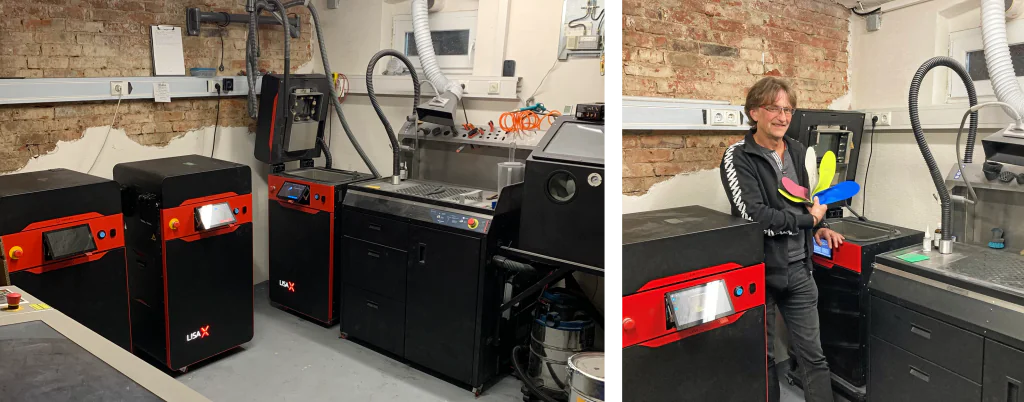
Lisa X built the production line. Paul Hast started with a single Lisa Pro, then scaled to three Sinterit Lisa X printers by 2022. Across the fleet, the team logged more than 14,000 printing hours, with one Lisa X passing 10,000 hours alone. Sinterit awarded Paul Hast first place in its global Lisa X usage competition.
Automation drove the volume. Paul Hast layered an algorithm and a digital insole library on top of the printers. Patient-specific templates now generate overnight rather than by hand.
"At the beginning, I had little experience with 3D printing. Today, we run an automated workflow with a digital insole library and algorithms generating patient-specific templates. What once took hours of manual labor now happens overnight in the printer," Hartung said.
Lisa X carried the high-performance jobs. Scaling everyday output needed a different platform. Sinterit positioned the Suzy as a compact, nitrogen-free SLS system to complement the Lisa X without competing with it. Paired with PA11.5, the Suzy delivered geometric freedom injection moulding and FDM cannot match.
"Even though we already had three Lisa X printers, Suzy turned out to be a fantastic complement. It gave us speed and cost efficiency without compromising quality. Together with PA11.5, it is our premium solution," Hartung said.
Print throughput climbed sharply once the new setup went live. In a follow-up update to Sinterit, Hartung described the shift in concrete terms:
"We have received the Suzy for printing and started it up with PA 11.5. The first prints turned out really well. But what's huge is we reduced printing time for a full build space by more than fifty percent. Thank you very much for convincing me to make the switch from PA12. I believe that we will be able to quickly implement a new product line with PA11.5 by the end of the year."
A 50% print-time reduction reshapes daily production economics. Faster builds mean more 3D printed orthopaedic insoles per machine per day, without compromising biomechanical performance.
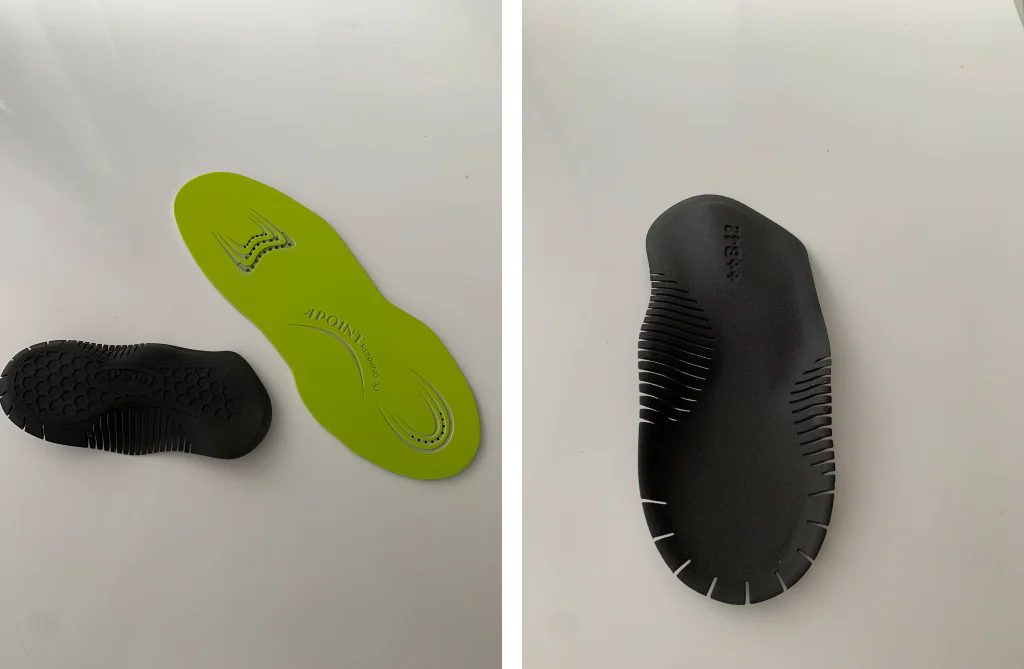
Combining the Suzy with PA11.5 delivered visible changes on the production floor and at the patient interface:
Lighter and more flexible insoles with better fit and durability for daily wear.
Higher patient satisfaction with individualised, advanced orthopaedic designs.
Three Lisa X printers anchoring high-performance work, with the Suzy carrying cost-efficient everyday production.
Nitrogen-free operation on the Suzy, which keeps PA11.5 production economics sustainable.
Australian orthopaedic manufacturers, podiatry clinics, and prosthetics labs find the Sinterit Suzy sits in a price bracket placing in-house SLS 3D printing within reach. Paired with PA11.5, the platform turns custom 3D printed orthotics from an outsourced expense into a daily, in-house workflow.
Looking forward, the workshop plans to keep FDM in research and prototyping. SLS 3D printing with the Suzy and PA11.5 will carry premium patient-specific production. The next milestone is a new PA11.5 product line, which Hartung intends to launch by the end of the year.
"Paul Hast GmbH continues to expand its digital orthopedic manufacturing capabilities. FDM is a valuable research platform, but premium patient care is delivered with Suzy and PA11.5. The more we innovate, the more people benefit from our century of orthopedic expertise," Hartung said.
Three Lisa X printers confirmed Paul Hast's pioneering role in additive manufacturing. Pairing Suzy with PA11.5 made 3D printed orthopaedic insoles scalable, affordable, and uncompromised, with daily output climbing alongside the new product line. Watch the Peter Hartung interview below for the full story.
What is PA11.5 and why does it suit 3D printed orthopaedic insoles?
PA11.5 is a Sinterit SLS powder engineered for parts requiring flexibility, lightness, and durability. For 3D printed orthopaedic insoles, the material delivers biomechanical performance injection-moulded TPU and FDM filaments do not reach. PA11.5 also runs on the nitrogen-free Sinterit Suzy, which keeps production economics manageable for daily output.
How does the Sinterit Suzy compare with the Lisa X for insole production?
The Lisa X is the higher-performance Sinterit SLS printer, built for industrial throughput and an advanced material range. The Suzy is a compact, cost-efficient platform aimed at everyday production scaling. Paul Hast runs both side by side: Lisa X for high-performance jobs, Suzy for scalable patient-specific insoles using PA11.5. For a closer look at the two side by side, see our Suzy vs Lisa X comparison.
Is SLS 3D printing scalable for healthcare manufacturing?
Yes. Paul Hast's three Lisa X printers logged over 14,000 printing hours, and the addition of the Suzy with PA11.5 cut full-build print time by more than 50%. With a digital insole library and an automated workflow, SLS 3D printing supports digital insole production at healthcare scale without sacrificing patient specificity.
Can you produce 3D printed orthopaedic insoles in Australia?
Yes. Sinterit Suzy and Lisa X printers are available in Australia, and PA11.5 powder ships with both. Australian orthopaedic manufacturers, podiatry clinics, and prosthetics labs are bringing SLS-based 3D printed orthopaedic insoles in house without the need to install nitrogen infrastructure.
What is the print-time difference between PA11.5 and PA12 on the Suzy?
Paul Hast reported a switch from PA12 to PA11.5 on the Sinterit Suzy reduced printing time for a full build space by more than 50%. The gain roughly doubles daily 3D printed orthopaedic insole output for the same machine hours.
Bringing 3D printed orthopaedic insoles in house in Australia starts with the right printer. Want to view our range of Sinterit SLS printers, including the Suzy and Lisa X? Click here.
Browse products related to the article
$38,160.00
$33,250.00
$1,309.00